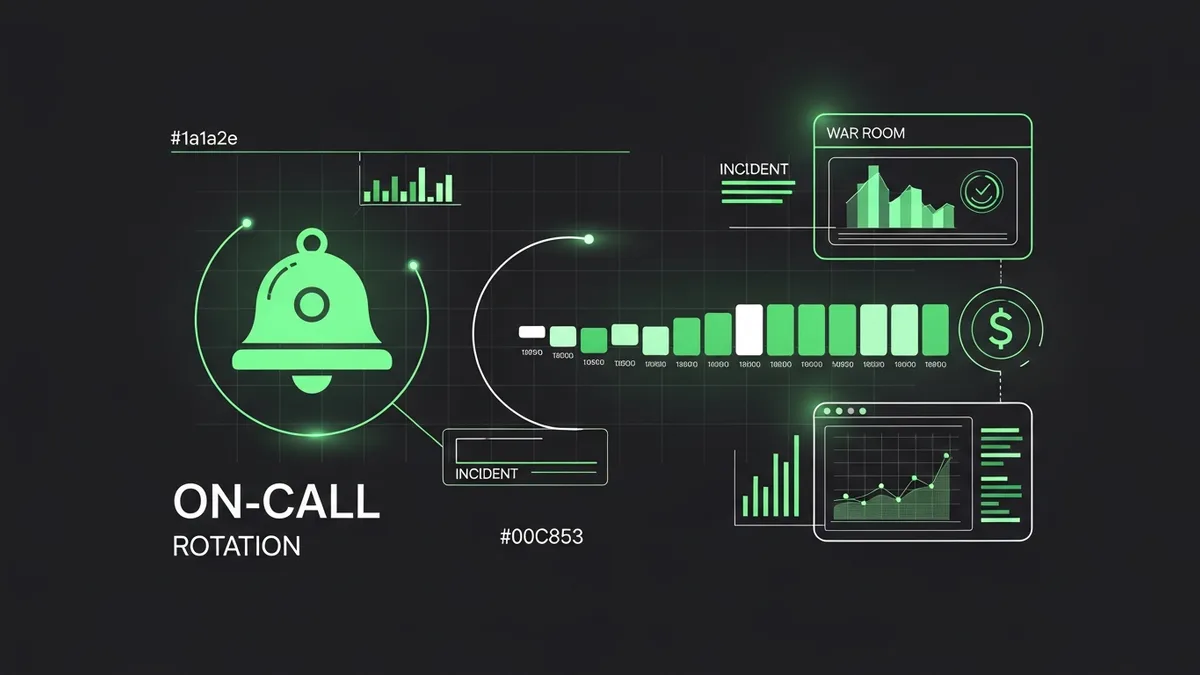
Last Memorial Day weekend, a client's landing page went down at 11 PM on Saturday. Nobody noticed until Tuesday morning. The ad campaigns kept running the whole time, burning through $6,800 sending traffic to a broken page.
Marketing Teams Need On-Call Rotations Too
Engineering teams have had on-call rotations for decades. Someone is always responsible for responding to production incidents, even at 2 AM. But marketing teams? Most don't have anything close to this.
And that's wild when you think about it. Your marketing funnel is a production system. It handles real money, real customers, and real revenue. When it breaks on a Friday night, someone should be watching.
I've talked to dozens of marketing ops managers about this. The most common response is "we check things Monday morning." That's a 60-hour gap between Friday evening and Monday at 9 AM. If your campaigns run on weekends (and most do), that gap is expensive.
Setting Up an On Call Rotation Marketing Team Actually Likes
Nobody wants to be glued to their phone on a Sunday. Fair. But an on call rotation marketing team doesn't have to be miserable. Here's how we've set it up for clients in a way that works:
- Rotate weekly, not daily (people need predictability)
- Only escalate real problems, not every minor alert
- Use FunnelLeaks to automatically check critical funnel pages every 15 minutes so the on-call person isn't manually refreshing dashboards
- Set up tiered alerts: Slack for warnings, phone call for critical failures
- Compensate on-call time (comp days, bonuses, whatever fits your culture)
The on-call person doesn't need to fix everything themselves. They need to triage, pause ad spend if something's broken, and escalate to the right person for a fix.
What Qualifies as a Marketing Incident?
Not everything is a fire. We teach teams to use three levels:
Critical: Landing page is down, checkout is broken, tracking is completely dead. Pause ad spend immediately and fix it.
Warning: Page is slow (over 5 seconds), form is throwing intermittent errors, conversion rate dropped 40% in the last 4 hours. Investigate within an hour.
Informational: Minor layout shift, non-critical image missing, test environment throwing errors. Log it and fix during business hours.
Google's Site Reliability Engineering framework calls this severity classification. We've adapted it for marketing ops and it works.
The Tools That Make On-Call Rotation Possible
You need three things: monitoring that catches real problems, alerting that reaches the right person, and a runbook that tells them what to do.
For monitoring, FunnelLeaks covers your funnel pages, forms, and checkout flows. For alerting, pipe alerts into PagerDuty or OpsGenie so they follow your on-call schedule. For runbooks, keep a simple doc with "if X, then do Y" instructions. Nothing fancy. Just clear steps.
This Mother's Day, Set Up the System
Your team deserves weekends off. An on call rotation marketing team with proper monitoring means one person keeps a light eye on things while everyone else recharges. Use code MOTHER26 for 20% off your first month at funnelleaks.app/pricing and get the monitoring side handled so your on-call rotation actually has something to work with.